
A prediction market lets people trade the outcome of a future event. Will inflation come in above 3% this quarter? Will a particular candidate win? Each contract pays $1 if the event happens and nothing if it does not, so its price sits somewhere between zero and a dollar and can be read as the market’s probability. That is the whole mechanism.
It has stopped being a curiosity. Combined trading volume on Kalshi and Polymarket, the two largest platforms, rose from $4.51B in September 2025 to $48.9B in July 2026.1 Intercontinental Exchange, the owner of the New York Stock Exchange, has put around $1.6B into Polymarket and now distributes its data to clients.2 Robinhood made $156M from event contracts in the second quarter of 2026, more than it made from equities trading.3 Part of the appeal is the data: these prices are increasingly read alongside polls as a live estimate of probability.
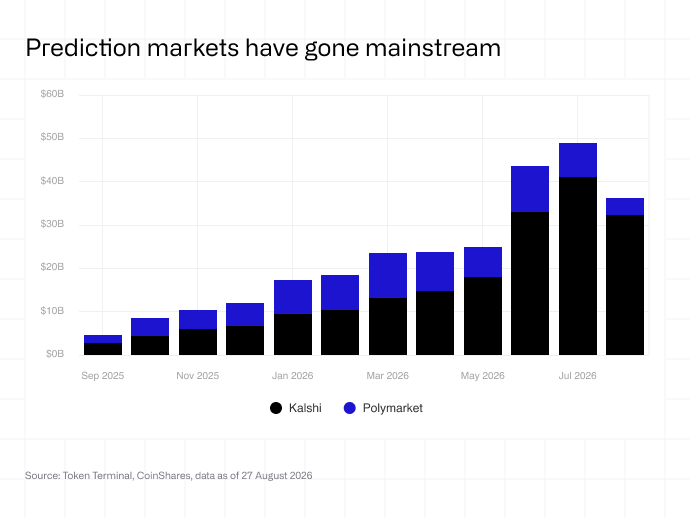
The problem for anyone who wants exposure is that neither leader can be bought. Kalshi is private, valued at $22B, and its chief executive said in June that it will not list this year, with reports pointing to 2027 or later.4 Polymarket is also private and has said it intends to issue a token at some point, without giving a date.5
What is left is the infrastructure. Every prediction market trade has to be recorded and settled somewhere, and increasingly that somewhere is a blockchain network. Two of them have built positions around this activity, Hyperliquid and Solana, and both have a token that trades: HYPE and SOL. Holding the token is the closest available proxy for the theme.
Two networks, two very different businesses
The difference between them will be familiar to anyone who has looked at exchange economics. Hyperliquid runs its own prediction market and charges a fee on the trade, much as an exchange charges on the contracts it lists. Solana does not run one. It is the network other firms’ prediction market apps sit on, and it earns a general transaction fee whatever those apps do. In the largest case it does not even earn that, because Polymarket’s contracts run on Polygon, a separate network.
Neither arrangement has produced much so far. Hyperliquid’s prediction market contributed $3,830 of revenue in the first 27 days of August, and its volumes have fallen every month since June.
Polygon is the clearest illustration. It hosts the largest prediction market in the world, and that has not turned into a rising income. Polymarket traded $7.7B in January and $10.6B in March. Over the same two months Polygon’s network revenue fell from $3.37M to $976k, and it has stayed well below its January level since. The cause was not a lack of activity. Polygon changed its fee mechanism in March 2026 so the network runs at full capacity, which made transactions cheaper and more predictable. That is good for the applications running on it, and it changes what the token captures from their activity. A network competing on price earns less per transaction however much business it attracts.
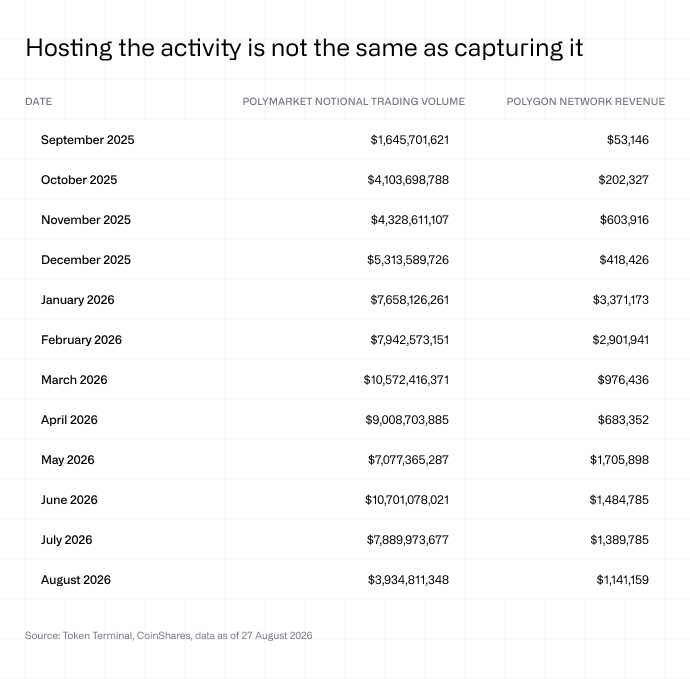
The question worth asking is therefore not who earns from prediction markets today, because essentially nobody does. It is which network has built a mechanism that could charge for the activity if it keeps growing. Fee mechanisms differ between these networks, and that difference will matter more than today’s volume figures. It is the thing to examine before treating any of them as exposure to the theme.
Sources
1 Token Terminal, Kalshi and Polymarket monthly notional trading volume, data as of 27 August 2026. Notional volume is the face value of contracts executed, not money committed.
2 Intercontinental Exchange, “Intercontinental Exchange Announces New $600 Million Investment in Polymarket,” 27 March 2026, following an initial $1B investment in October 2025.
3 Robinhood Markets, second quarter 2026 results release, 29 July 2026. Event contracts revenue $156M against equities revenue of $129M.
4 CNBC, interview with Kalshi chief executive Tarek Mansour, 24 June 2026.
5 Public comments by Polymarket’s chief marketing officer, October 2025. No launch date, supply or eligibility criteria published as of 28 August 2026.