
Two different ways to own the same trend
Most routes into digital assets give an investor the price of the asset and nothing else. When bitcoin falls, the position falls with it, and the conversation with the client becomes a conversation about market timing.
There is a second route, and it behaves differently: the listed companies that operate the industry itself. They are ordinary equities, held in a UCITS fund, with none of the custody and suitability complexity of direct digital asset exposure. They also generate revenue, which means there is something to value beyond sentiment.
You are buying the industry, not the price
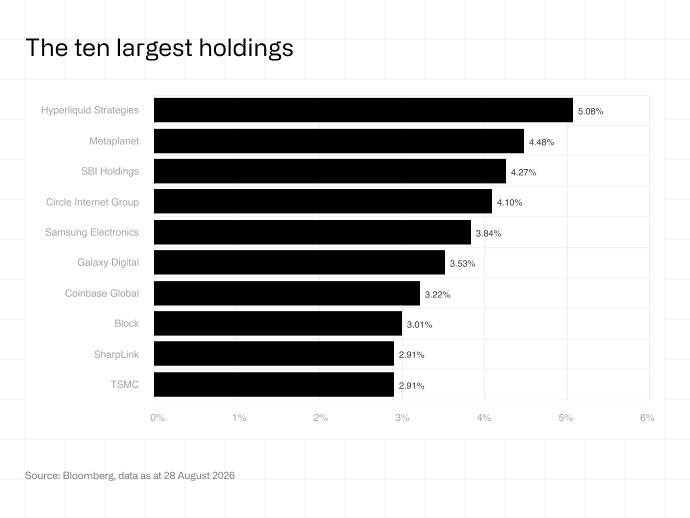
The CoinShares Blockchain Global Equity Index holds companies that earn revenue from the digital asset economy rather than from holding the asset itself: exchanges and brokers, payment processors, stablecoin issuers, tokenisation infrastructure, semiconductor manufacturers and bitcoin miners. The top holdings include recognisable names: Samsung and TSMC, as well as blockchain bellwether names, including Coinbase and Circle.1
That composition changes the tone of the conversation. The investment case rests on transaction volumes, use cases, adoption and company earnings. It is a financial infrastructure allocation, not a directional crypto trade, and it does not carry the custody and suitability complexity of direct digital asset exposure.
The building has not stopped
Bitcoin closed August 2026 around 37% below its October 2025 peak, and sentiment across the sector has followed it down.2 The operating picture looks different. Over the same window, the value of tokenised funds, equities and commodities held on public blockchains grew from $29.2B to $44.7B, an increase of 53.1%.3 That is a marked contrast with 2022, when the industry retrenched and went defensive. This time the infrastructure has continued to be built while the token price has fallen.
A full cycle of evidence
The strategy has been live since March 2019, through the 2021 peak, the 2022 bear market, the recovery and the current correction. It went through the ups with the downs. That history is the point of it. In 2022, the ETF that tracks the Index declined 52.0% while bitcoin fell 64.3% (in USD terms).4 Diversification across revenue-generating businesses has softened crypto drawdowns, providing a cushion against the underlying digital asset industry volatility.
Correlation runs at around 0.46 to bitcoin and 0.40 to the Nasdaq (over the year to 18 September 2026), low enough to count as genuine diversification and delivered alongside a positive return.
None of which makes this a defensive holding, and the portfolio is not completely free of bitcoin. The miners, which account for c.20% of the Index, earn in close proportion to the bitcoin price, and the index’s largest positions also include digital asset treasury companies whose balance sheets are held in crypto.1 Annualised volatility sits above 36% and the maximum drawdown since launch is 61%. The strategy is up 26.6% in 2026 to the end of August, having averaged more than 40% per annum over the three preceding calendar years.4 Position sizing should reflect both halves of that record.
What to watch next
Digital assets have long lived within a grey area, and the CLARITY Act was intended to set out which regulator would supervise the digital asset industry. Despite having failed at the Senate, regulation remains a core theme in the industry, and rule setting should stay with the SEC and CFTC for the time being. And while in the past both entities have taken a hawkish stance in relation to digital assets, more recently they have been adopting a friendlier and more collaborative approach when regulating this industry. As these rules become clearer, so will earnings visibility, which should remove some of the overhang that has sat on sector valuations since 2019.
For advisers who want the growth of the ecosystem without the wrapper problem, the entry point deserves a serious look.
Disclaimer
High risk of capital loss. Investments should be made on the basis of the information (including for the avoidance of doubt risk factors) in the current prospectus and the relevant key information documents which are available on https://coinshares.com/ and https://www.invesco.com/ch/en.
Past performance is not indicative of future results.
Sources
1 Solactive, CoinShares Blockchain Global Equity Index constituents, 27 August 2026
2 Token Terminal, bitcoin daily closing price, 6 October 2025 and 28 August 2026
3 Token Terminal, circulating market cap of tokenised funds, tokenised equities and tokenised commodities, 6 October 2025 and 28 August 2026
4 Bloomberg, September 2026