
The stablecoin market reached $314 billion in 2025, processing $33 trillion in transaction volume—more than Visa and Mastercard combined. Standard Chartered projects the sector could grow to $2 trillion or beyond by 2030. For advisers, it brings a crucial question: how to gain portfolio exposure to their growth?
Introducing stablecoins
Stablecoins are dollar-pegged digital currencies used for trading, payments, and settlement across blockchain networks. They’ve become critical infrastructure: the liquidity layer that enables everything from decentralised finance to cross-border remittances. Tether’s USDT commands roughly 60% market share at $187 billion, while Circle’s USDC holds 25% at $75 billion. Together they dominate, but the economics of each flow to different beneficiaries.
The most direct listed exposure came in June 2025 when Circle went public on the NYSE under ticker CRCL. The IPO was oversubscribed 25 times, and shares surged over 160% on the first day. Circle earns revenue primarily from interest on USDC reserves—cash and short-term Treasuries backing every token. As USDC supply grows, so does reserve income. The company also operates the Circle Payments Network, positioning itself as an infrastructure for institutional stablecoin adoption.
But Circle’s economics don’t exist in isolation. Coinbase (COIN) receives 50% of USDC reserve revenue under its partnership agreement—approximately 15% of Coinbase’s total revenue in 2025. For investors already exposed to Coinbase through crypto exchange activity, there’s an embedded stablecoin upside they may not have considered. As USDC grows, Coinbase’s share of reserve income scales proportionally.
Stablecoins integrated into payment networks
Payment networks offer another avenue. Visa and Mastercard have both integrated stablecoin settlement into their infrastructure, recognising that blockchain-based dollars can reduce settlement times and costs. Rather than being disrupted by stablecoins, these networks are incorporating them. PayPal launched its own stablecoin, PYUSD, which reached nearly $3 billion in market capitalisation by late 2025. For PayPal shareholders, stablecoin adoption represents incremental upside to the core payments business.
Layer 1 blockchains also benefit. Ethereum hosts approximately 50% of all stablecoin value, while Solana has grown rapidly as a settlement layer for USDC and other tokens. When stablecoin activity increases—whether for trading, DeFi, or payments—transaction fees accrue to these networks and their validators. Advisers with exposure to ETH or SOL through ETPs are indirectly participating in stablecoin growth.
There’s a second-order effect worth noting: stablecoins fuel crypto trading volumes. The majority of trading pairs on exchanges use USDT or USDC as the quoted currency. When stablecoin supply expands, it typically correlates with increased trading activity across digital assets. This benefits exchanges like Coinbase, but also supports valuations across the broader crypto market—including Bitcoin and Ethereum, accessible through regulated ETPs.
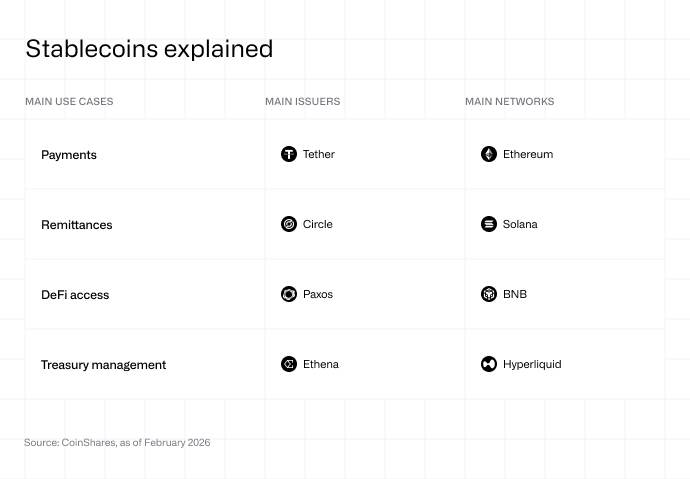
Different avenues to get exposure to stablecoins
For advisers evaluating this space, the framework is straightforward. Direct exposure comes through Circle (CRCL), though as a newly public company it carries execution risk. Diversified exposure comes through Coinbase (COIN), which benefits from both exchange activity and USDC revenue sharing. Traditional finance exposure comes through payment networks adapting to blockchain settlement. And indirect exposure comes through Layer 1 blockchains and crypto ETPs that benefit from stablecoin-driven liquidity.
The regulatory picture has been clarified. The US GENIUS Act, passed in July 2025, established federal oversight for stablecoin issuers, while Europe’s MiCA regulation provides a compliance framework for the EU market. There is now regulated financial plumbing with identifiable beneficiaries.