
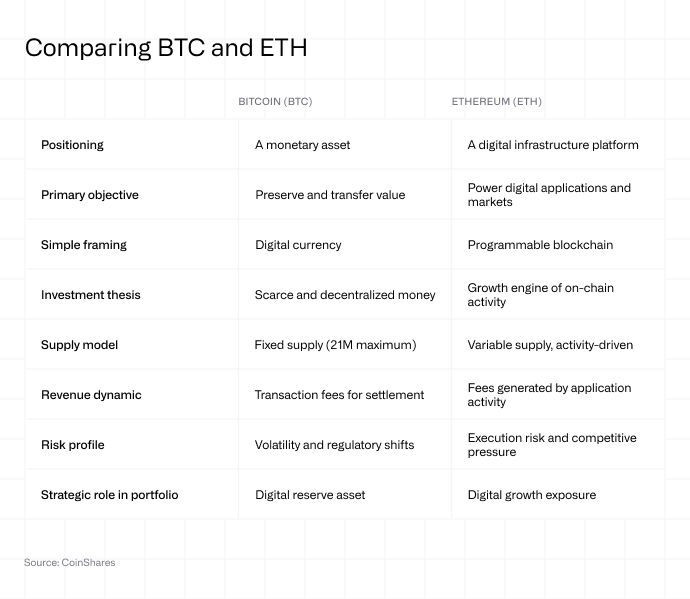
Despite sharing blockchain foundations, these assets serve fundamentally different purposes. Bitcoin is a reserve asset. Ethereum is a programmable infrastructure. Understanding this distinction helps shape portfolio positioning.
Two assets with different characteristics
Bitcoin emerged in 2009 from the financial crisis, designed as a peer-to-peer payment system that removes intermediaries from transactions. Its pseudonymous creator, Satoshi Nakamoto, capped the total supply at 21 million coins, with new coins entering circulation through rewards paid to miners who validate transactions. This scarcity, combined with durability and portability, has led many to compare Bitcoin to digital gold. It has become popular as a corporate treasury asset and, for individual investors, as an alternative store of value outside the traditional monetary system.
Ethereum launched in 2015 with broader ambitions. Its co-founder Vitalik Buterin described it as a “world computer”—an incredibly large and diverse on-chain economy. Where Bitcoin records transfers of value, Ethereum executes smart contracts: programs that automatically run when preconditions are met. This programmability enables decentralised applications (dApps) that operate without intermediaries, disrupting legacy financial services and enabling entirely new categories like decentralised finance (DeFi) and tokenised assets.
The technical architectures reflect these different goals. Bitcoin uses proof-of-work (PoW), requiring miners to solve complex mathematical problems to validate transactions. This energy-intensive process secures the network but limits transaction throughput. Ethereum transitioned to proof-of-stake (PoS) in September 2022, reducing energy consumption by an estimated 99.95% while allowing holders to earn rewards by staking their tokens to validate transactions.
A complementary allocation for institutions
From an investment perspective, these differences translate into distinct characteristics. Bitcoin operates as a monetary settlement layer. Its value proposition centres on scarcity, durability, and independence from central authority. It tends toward lower volatility relative to other digital assets and has achieved the widest institutional adoption, with ETPs now holding over $176 billion in assets.
Ethereum functions as a utility engine for applications. Its value derives from demand for computational resources on its network—every smart contract interaction requires payment in ether. Ether ETPs hold approximately $25 billion in assets. The network dominates tokenised real-world assets and hosts the majority of stablecoin supply, representing a substantial institutional opportunity.
Institutional behaviour confirms the complementary relationship. Research by CoinShares using regulatory filings shows that 93% of institutions holding Ethereum ETFs also invest in Bitcoin products. The overlap works both ways: 61% of Bitcoin ETF assets belong to firms invested in both cryptocurrencies. Wall Street allocators increasingly treat them as complementary exposures rather than competing options.
The most mature digital assets
For portfolio construction, Bitcoin offers exposure to a non-sovereign store of value with programmed scarcity—a monetary hedge. Ethereum provides exposure to programmable finance infrastructure where activity generates transaction fees and staking rewards. Both carry volatility, but they respond to different drivers: Bitcoin to macroeconomic conditions and institutional flows, Ethereum to application adoption and network usage.
As Bank of America noted, “blockchain technology could underpin a new generation of financial vehicles.” Bitcoin and Ethereum represent the two most mature examples—different by design, complementary in function, and increasingly recognised by institutions as distinct pillars of a diversified digital asset allocation.