
Clients exploring crypto beyond Bitcoin often encounter Solana. It shows up in diversified crypto products, altcoin discussions, and increasingly in institutional research. For advisors, the question becomes: what does Solana exposure actually represent?
The short answer is infrastructure. Solana is a blockchain built for speed, designed to settle financial transactions at scale. Understanding what it does- and why institutions are paying attention- makes the conversation easier.
What Solana actually is
Solana is a blockchain optimised for throughput. Its architecture processes tens of thousands of transactions per second at fees of around $0.03, with settlement times under half a second. For context, traditional wire transfers can take days and cost several dollars. Even other blockchains struggle to match Solana’s combination of speed and low cost.
This matters because modern financial applications demand fast, cheap, reliable infrastructure. Payments, trading, lending, and tokenisation all require networks that can handle volume without congestion. Solana was built for that purpose.
The network is now the second-largest blockchain by total value locked, with over €10 billion deposited across decentralised applications. Two platforms dominate: Jupiter, a decentralised exchange handling token swaps and perpetual futures, and Jito Network, a liquid staking protocol that lets users earn rewards while keeping assets usable across the ecosystem.
Where the activity is
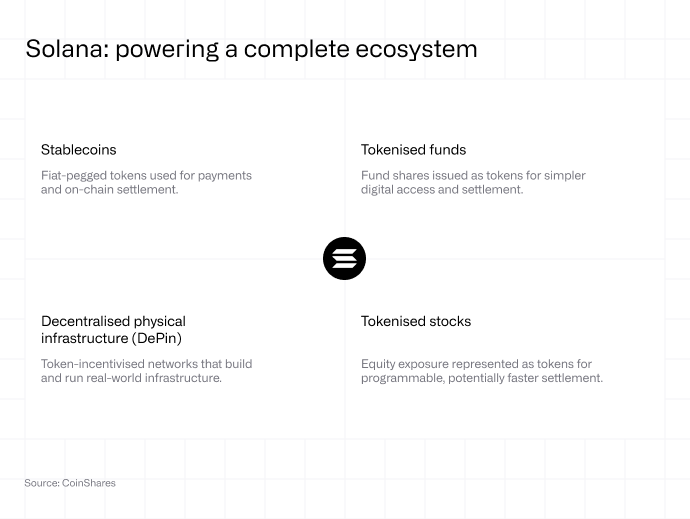
Solana has carved out a strong position in stablecoins, the dollar-pegged tokens that now represent the clearest mainstream use case for blockchain technology. In the year to September 2025, Solana processed €330 billion in stablecoin transactions- 5% of the global total. Visa’s decision to settle USDC transactions directly on Solana marked a turning point: institutional-grade payments infrastructure, running on a public blockchain.
The network also hosts a growing share of tokenised real-world assets. Over $400 million in RWAs now sit on Solana, rising to over $12 billion when stablecoins are included. Tokenised Treasury bills, money market funds, and other dollar-denominated instruments are finding a home on the network because its throughput can handle institutional volumes.
Decentralised physical infrastructure networks- DePINs- are another growth area. Projects like Render, a GPU-sharing marketplace used by Hollywood production houses, and Helium, a decentralised wireless network, rely on Solana’s ability to process thousands of small payments cheaply. These aren’t theoretical use cases; they’re operating at scale.
The institutional signal
Solana’s credibility was tested severely during the FTX collapse in late 2022. The exchange had deep ties to the network, and when it imploded, SOL fell nearly 97%. Many wrote it off as finished.
What happened next was instructive. The network kept running. Developers kept building. And within two years, SOL had recovered from under $10 to around $200. BlackRock expanded its BUIDL tokenised fund to Solana. Franklin Templeton brought its FOBXX fund to the network. Visa integrated Solana into its stablecoin settlement operations.
These aren’t speculative bets but infrastructure decisions by institutions that move slowly and deliberately.
What exposure represents
Allocating to Solana means taking a position on high-performance blockchain infrastructure. It’s a bet that speed and low cost will continue to attract applications, developers, and capital, and that the network will capture value as transaction volume grows.
This is different from Bitcoin, which functions primarily as a store of value, or Ethereum, which anchors programmable finance. Solana occupies a distinct niche: the fast lane for financial applications that need scale.
For clients seeking exposure to the broader crypto ecosystem beyond Bitcoin, Solana offers a way to participate in infrastructure growth. Crypto ETPs tracking SOL are available through standard custody arrangements, making allocation practical for advisory portfolios.
The question for advisors is whether clients want exposure to this layer of the digital economy. If the answer is yes, Solana has become one of the most credible options available.