
Professionals comfortable with a Bitcoin allocation often face a follow-up question: what about everything else?
The case for Bitcoin is well established- diversification, scarcity, institutional adoption. But Bitcoin represents one use case: a store of value. The broader crypto ecosystem includes infrastructure for programmable finance, stablecoins, and tokenisation. Clients interested in that exposure need a different kind of allocation.
This article outlines how to think about constructing a crypto sleeve that includes altcoins- and how different mixes can serve different objectives.
Starting with structure
A crypto allocation sits within a broader portfolio. The first decision is size: CoinShares’ research points to 5% as the level where diversification benefits outweigh added volatility. Within that sleeve, the question becomes composition.
The simplest approach is Bitcoin only. It’s the most liquid, least volatile (relative to other cryptos), and easiest to justify compliance. For clients seeking pure diversification without complexity, this may be enough.
But a Bitcoin-only allocation leaves the rest of the ecosystem untouched. Ethereum, Solana, and other networks are building real infrastructure- and in some cycles, they’ve outperformed Bitcoin significantly. Clients willing to accept more volatility for higher potential upside may benefit from a blended approach.
Illustrative allocations
Consider three models, each assuming a 5% total crypto allocation within a 60/40 equity-bond portfolio:
The first is Bitcoin-only. The entire 5% goes to BTC. This is the conservative option- simple, defensible, and focused on the most institutionally accepted asset.
The second is Bitcoin-dominant with Ethereum. Allocate 4% to Bitcoin and 1% to Ethereum. This introduces exposure to programmable finance and tokenisation while keeping the majority in the anchor asset.
The third is a diversified mix. Allocate 2.5% to Bitcoin, 1.25% to Ethereum, and 1.25% split between Solana and XRP. This provides broader exposure to infrastructure, speed-focused networks, and payments- at the cost of higher volatility.
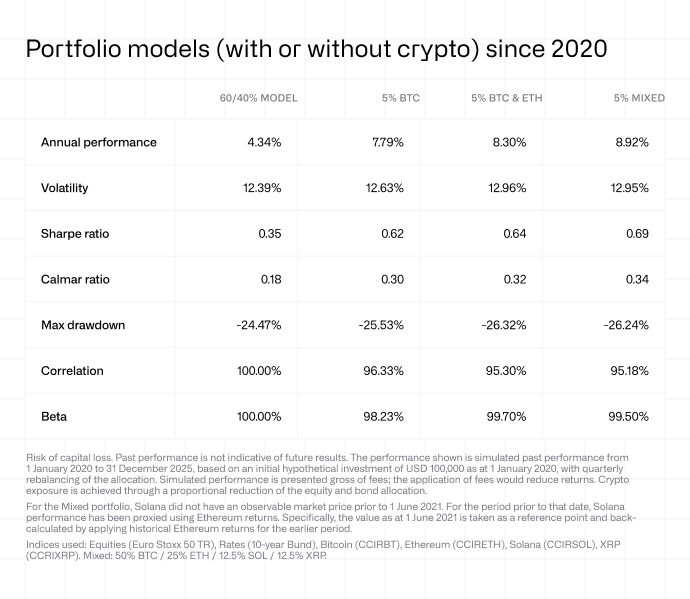
CoinShares’ simulations from 2020 to 2025 show that diversified crypto allocations delivered higher returns than Bitcoin-only, though with greater drawdowns during stress periods. The trade-off is real: more assets means more volatility, but also more participation in the ecosystem’s growth.
Matching allocation to objective
Different clients have different goals. A conservative client seeking modest diversification may prefer Bitcoin only. A growth-oriented client comfortable with volatility may favour the mixed approach. The allocation should reflect the client’s risk tolerance, not the advisor’s enthusiasm for any particular asset.
It’s also worth considering what each asset represents. Bitcoin is a macro hedge and store of value. Ethereum powers decentralised finance and tokenisation. Solana offers speed and low transaction costs. XRP focuses on cross-border payments. Each fills a different role in the emerging digital economy.
A diversified crypto allocation isn’t about picking winners. It’s about maintaining exposure to multiple use cases, so the portfolio benefits regardless of which segment gains traction.
Rebalancing and discipline
Crypto allocations drift quickly. A 5% position can become 8% or more after a rally, shifting the portfolio’s risk profile. Regular rebalancing- quarterly or when thresholds are breached- keeps the allocation aligned with intent.
This is especially important with altcoins, which can move sharply in either direction. Trimming winners and rebalancing back to target enforces discipline and locks in gains over time.
Practical considerations
For most advisory practices, crypto ETPs offer the cleanest access. Products tracking Bitcoin, Ethereum, and baskets of altcoins are now available through standard custody arrangements, removing the operational burden of direct ownership.
The question isn’t whether altcoins belong in portfolios- it’s how much, and in what combination. The answer depends on the client. But having a framework makes that conversation easier.