
Bitcoin dominates headlines and allocations, and for good reason: it’s the most liquid, most recognised, and most institutionally adopted digital asset. But treating crypto as synonymous with Bitcoin means closing the door on a broader opportunity set.
The case for looking beyond Bitcoin isn’t about replacing it. It’s about optionality: maintaining exposure to different parts of an evolving ecosystem, so that when one segment takes off, the portfolio participates.
What optionality means in practice
In digital assets, the landscape shifts fast. Use cases that barely existed five years ago- stablecoins, decentralised finance, tokenised securities- now move hundreds of billions of dollars. Networks like Solana and Sui have emerged as serious infrastructure players. Protocols like Aave and Hyperliquid are generating real revenue from lending and trading.
None of this was predictable in 2019. And what the market will look like in 2030 is equally uncertain.
Optionality is the strategy of staying positioned for multiple outcomes. Rather than betting everything on one asset or narrative, it means holding a diversified mix that can benefit from whichever segment of the market gains traction next. Bitcoin remains the anchor. But a portfolio with no exposure beyond it has no flexibility if the growth comes from elsewhere.
The asymmetry argument
Altcoins carry more risk than Bitcoin. They’re less liquid, more volatile, and many will fail outright- over half the tokens listed since 2021 have already disappeared. But the ones that succeed can deliver returns that dwarf anything in traditional markets.
This is asymmetric risk: the downside is capped at what you invest, while the upside, in rare cases, can be transformational. Ethereum has returned significant multiples since inception. Solana, despite a brutal drawdown in 2022, has returned over 10,000%. These are outliers, but outliers are the point. A portfolio only needs one to offset a string of smaller losses.
The logic resembles early-stage venture capital, except altcoins are liquid and accessible to retail investors. That combination, think startup-like upside with public-market liquidity, is unusual in finance.
Where the infrastructure is being built
Beyond speculation, altcoins power real infrastructure.
Ethereum remains the backbone for decentralised finance, stablecoins, and tokenisation. Solana and Sei offer speed and low fees, attracting developers building the next generation of applications. Protocols like Aave manage over $25 billion in deposits; Hyperliquid processes sub-second trades and generates hundreds of millions in quarterly revenue.
Stablecoins alone now exceed $300 billion in market capitalisation, with daily volumes routinely surpassing $200 billion. Visa is testing them for cross-border settlement. Traditional finance is not ignoring this but is integrating it.
For advisors, this presents a choice: treat emerging digital assets as noise, or recognise that some of them are building the financial rails of the next decade.
How to think about allocation
Optionality doesn’t mean reckless speculation but thoughtful diversification within a volatile asset class. Don’t forget that in a basket of buzzy stocks in 2000, there was an Amazon sitting alongside the vaporware. Nowadays, no one would dare to say it wasn’t worth getting exposure to this kind of basket.
Bitcoin serves as the foundation- stable relative to other cryptos, widely understood, and supported by regulated products. Ethereum adds exposure to programmable finance. A selective allocation to smaller assets- chosen for utility, developer activity, and institutional traction- provides the asymmetric upside.
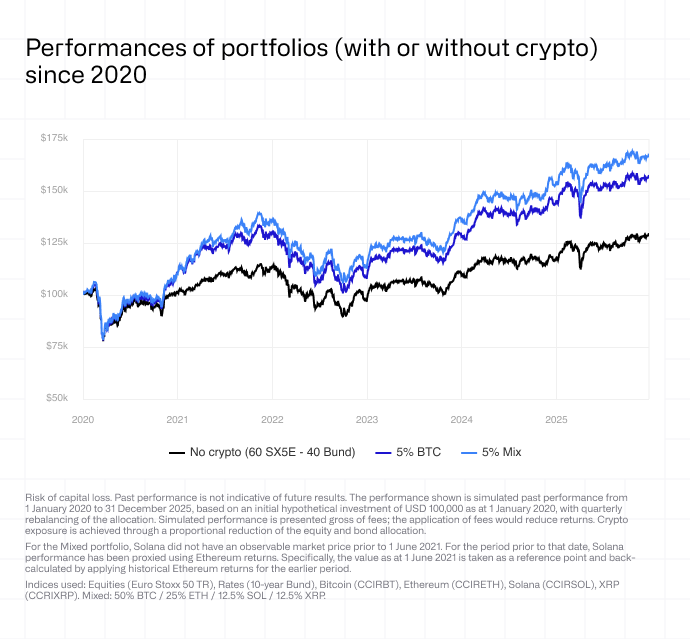
The key is discipline: sizing positions appropriately, rebalancing regularly, and accepting that most individual bets won’t pay off. The goal is to be positioned when one does.
Staying flexible
The only certainty in digital assets is change. Networks rise and fall. Narratives shift. Today’s experiment becomes tomorrow’s infrastructure, or disappears entirely.
Optionality is the hedge against not knowing which path the market takes. It keeps doors open. And in a space moving this fast, that flexibility may be the most valuable position of all.